How do you make a reading bingo card you will actually finish?
The short answer: Build a card of small, specific squares that mix easy and hard ones, choose books you already own for most of them, and decide up front what counts as a win, either a line or a full card. In Dog-Ear, the Reading Bingo page in the journal gives you a card of 12 squares you can edit, add to and tick yourself.
A bingo card turns reading into a game, and games are easier to keep playing than a goal. "Read 40 books" can feel far away. "Fill the square for a book with dragons" is something you can do this month. But a card only works if you can finish it, and many cards die by March because a few squares are too hard.
What makes a good bingo square?
A good square is specific, short and doable:
- Short. Two or three words reads best. "Book with a map" beats a full sentence.
- Specific. "Read a mystery" is clearer than "try something different."
- Doable from your own shelf. If a square needs a trip to a store for a rare book, it will stay empty. Most of the card should be something you already own or can get from a library. Our post on what a TBR is can help you see what you already have.
- One book, one square is the usual rule, though you can allow one book to fill two if you say so up front.
What are some square ideas?
Mix three kinds, so the card has a little of everything.
Easy squares (a book you probably own):
- A fantasy book
- A romance
- A book under 300 pages
- A book with a purple cover
- A physical book
- A Kindle book
Medium squares (a small push):
- A 500 page book
- A book by a new author
- Start a series
- Finish a series
- A reread
- A book a friend recommended
- A book you picked for its cover
Fun squares (about how you read):
- Read in one sitting
- Read outside
- Read it all in bed
- Finish a book in a day
- A book that made you cry
- A book from the bottom of your TBR
If you are not sure what to ask friends for, our post on sending a book recommendation to a friend shows a simple way to ask and share.
What should count as a win?
Decide before you start. The common options are:
- One line. Casual and quick. Good if you want a win by spring.
- A full card. Also called a blackout. Good if you like a year long goal.
- A set number of squares. For example, nine of twelve. A middle path.
There is no right choice. A card you win once feels better than a card you quietly abandon.
How big should the card be?
A smaller card is easier to finish. Nine or twelve squares fits most readers, and a classic 25 squares is a lot for one year. If you like the look of a big card, pick a longer deadline, such as two years, or give yourself a free square in the middle.
How do you make a card in Dog-Ear?
Dog-Ear's journal has a Reading Bingo page for each year. The side tab says Bingo.
- A card is made for you. The first time you open it for a year, you get a card of 12 squares. It starts with squares like 500+ pages, New author, Reread, Finish a series, Start a series, Fantasy, Romance, Physical book, Kindle book, 5-star read, Book with dragons and Book bought this year.
- Tap a square to tick it. Tap again to untick. You tick squares yourself. The page counts them, for example "3 of 12 squares."
- Edit squares. Tap Edit squares to change a square's words, remove it, or add your own, with a hint like "Read on a plane." Tap Done editing when you are finished.
- Random pick. Tap Random pick and Dog-Ear picks one open square and a book you own and have not read that could fit it, like "Square: Fantasy. Try: a title by an author." If nothing on your shelf fits, it says so.
- New random card. This draws a fresh card of 12 squares for the year, mixing the starter squares with fun ones such as Read in one sitting, Enemies to lovers, Vampire book, Picked for its cover, Book that made you cry and Book from the bottom of your TBR. It asks you to confirm first, because it clears the ticks on the current card.
A few honest limits. Dog-Ear does not draw a grid line or announce a win, so you decide what counts as a bingo. The squares are not filled in for you, so you tick them. And Random pick only uses books you own.
It sits next to the other journal pages, so you can run a bingo card and a goal side by side. Our post on setting a reading challenge you will finish covers how to choose that goal. If you like a game with a clear rule, an A to Z reading challenge is another one to try.
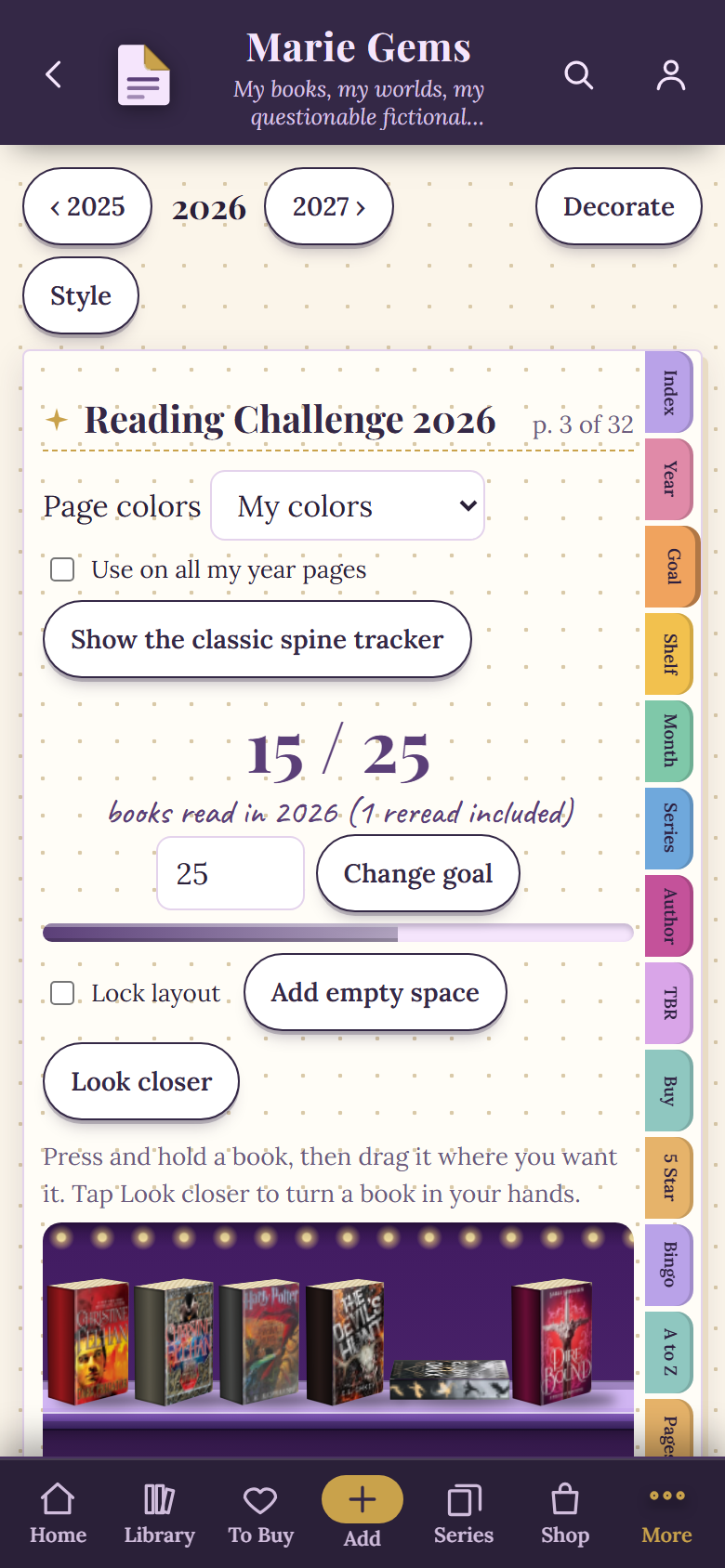
A journal page with its side tabs, including Bingo, in a sample library.
How do you keep a card moving?
- Put it where you will see it. A card you open once never gets filled.
- Tick one square a month at least. Small wins keep it alive.
- Swap a square. If one is too hard, change it. A card is yours.
- Pair squares with your reading mood. If you want something cozy, look for the square that fits.
When is this not for you?
If a card makes reading feel like a chore, skip it. Some readers want to read what they feel like, with no list. That is fine, and the reading slump guide on this blog can help when the chore feeling grows.
Start a card for the new year
If you are curious, Dog-Ear is at dogearreads.com. A pencil and a printed grid will play the same game.
Start freeQuestions
What should I put on a reading bingo card?
Mix easy squares (a genre you like), medium squares (a long book, a new author) and fun squares (read outside, a book from the bottom of your TBR). Keep each square to two or three words.
How many squares should a reading bingo card have?
Nine or twelve is easy to finish, and 25 is the classic size. Use a bigger card only if you give yourself more time.
Does a bingo win need a full card?
You choose. A line is quick, and a full card is a bigger goal. Decide before you start.
Can I make my own bingo squares in Dog-Ear?
Yes. On the Reading Bingo page tap Edit squares to change the words on a square or add your own.
Does Dog-Ear fill in the squares for me?
No. You tap a square to tick it. Random pick can suggest a book you own for an open square.
Related: How to set a reading challenge you will finish, What is a TBR pile, and how do you get through it?, How to send a book recommendation to a friend.