How to set a reading challenge you will actually finish
The short answer: to set a reading challenge you will finish, start from how many books you actually finished last year, add only a little, and decide before January what counts. Then leave room for slow months, and check your progress every quarter so you can adjust early instead of giving up late.
Most reading challenges do not fail in December. They fail in March, when the number you chose on January 1 turns out to belong to a version of you with more free time. Here is how to build one from real habits instead of hopes.
Start from what you really read
Count the books you finished last year, including the short ones and the audiobooks. That is your honest baseline. A common rule of thumb is to add about a fifth to a third on top, or a few books, so the goal feels like a stretch without being a trap. Jumping from five books to fifty rarely works.
| Finished last year | A reasonable goal | That works out to |
|---|---|---|
| 6 books | 7 to 8 books | About one every 6 to 7 weeks |
| 12 books | 14 to 16 books | A little more than one a month |
| 24 books | 29 to 31 books | About one every 12 days |
| Not sure | Track this year, then choose | Next year's goal will be based on real numbers |
These are rule of thumb numbers, not research. If you do not know last year's total, pick a modest number and let a free book tracker give you real data for next year.
Decide what counts before you begin
Rules made up in November, when you are four books short, quietly ruin challenges. Write them down in January:
- Formats. Do audiobooks and ebooks count? Most readers say yes.
- Rereads. Does finishing a favorite again count as a book? It is your challenge, so you decide.
- Short books. Novellas and graphic novels can all count, or none can. Pick one rule.
- Did not finish. Giving up on a book you do not enjoy should not cost you anything. Leaving DNFs out of the count means you are free to quit a bad book.
Books or pages
| Goal type | Good when | Watch out for |
|---|---|---|
| Number of books | You read books of similar length and want a simple number you can picture. | It can push you toward short books and away from a long one you want to read. |
| Number of pages | Your books vary a lot in length, or you read a few very long ones. | It can reward picking thick books, and it needs a page count for every book. |
| Both | You want the satisfaction of finishing books and a fair measure of effort. | Two numbers to keep an eye on. |
Build in a buffer
Reading is uneven, so a goal that needs the same pace every month leaves no room for real life. Three habits help:
- Set the goal a little below your ceiling. Finishing early feels better than chasing in December.
- Bank some books early. A fast first quarter covers a slow summer.
- Use quarter checkpoints. For a goal of 24, aim for about 6 by the end of March, 12 by the end of June and 18 by the end of September. If you are well under at a checkpoint, you still have time to adjust calmly.
Choose your next book before you finish the current one. The gap between books is where momentum often fades. If a book is the problem, our guide to getting through a TBR pile can help, and if the whole habit has stalled, read about reading slump causes and fixes.
What to do when you fall behind
Falling behind does not mean you failed. It means the plan met reality. Work down this list in order:
- Look at the real gap. A gap of two books is very different from a gap of ten.
- Check what you left out. Audiobooks or rereads may belong in, if your own rules allow it.
- Add a few short books. A couple of quick reads can close a small gap and are a pleasant break from a heavy one.
- Change the goal. If the number no longer fits your life, lower it. A goal you finish at a lower number beats one you abandon.
- Switch measures. If long books are the issue, move to a pages goal.
How Dog-Ear tracks a reading challenge
Dog-Ear's reading journal has a Reading Challenge page. Open More, then Reading Journal, then the Goal tab. You set a number of books for the year, and the page shows how many you have read as a count such as 15 of 25, with a progress bar and a line saying how many books are left. Each year has its own goal.
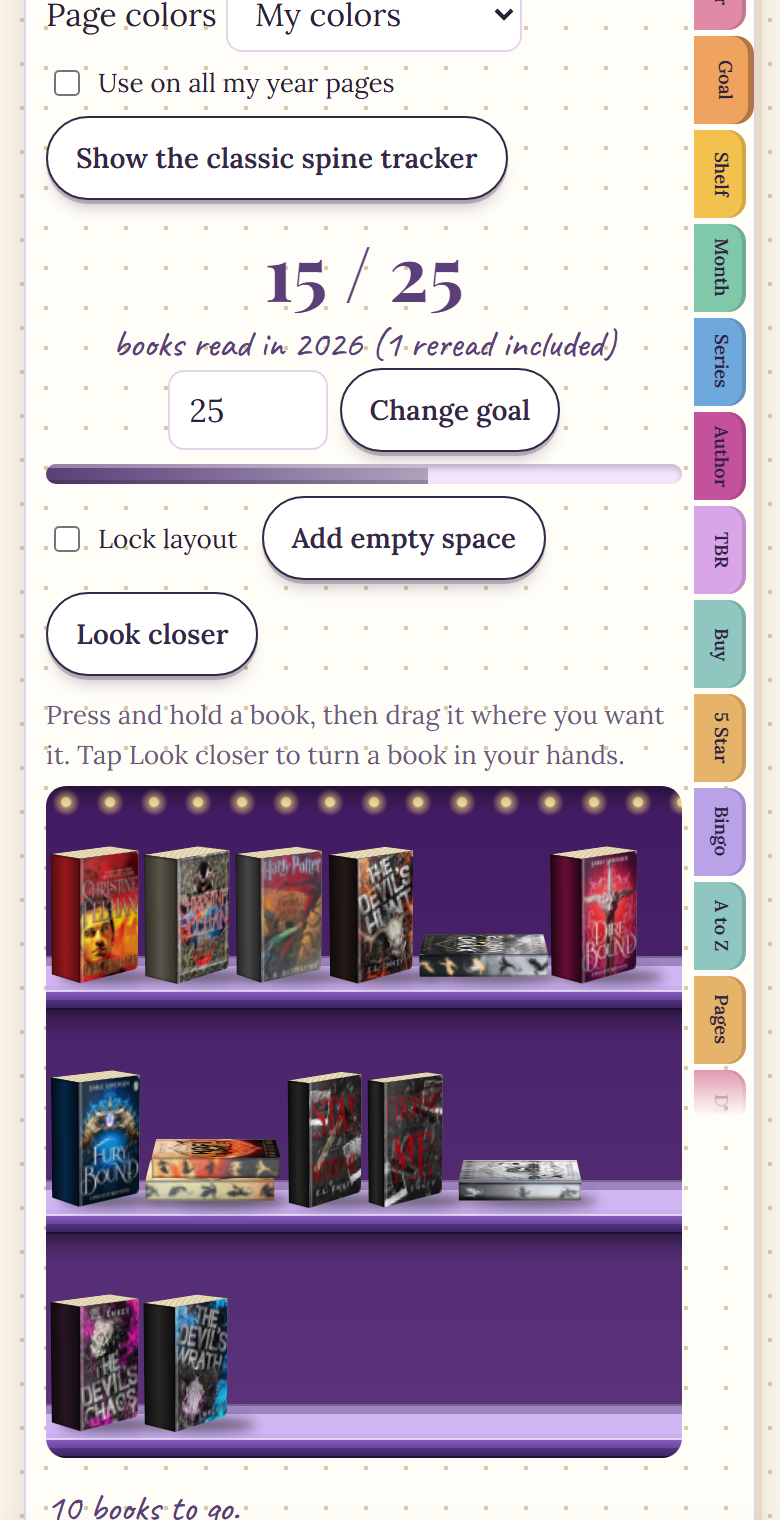
The Reading Challenge page in a sample library, with the goal set to 25 books.
Here is exactly how it counts, from how the app works:
- Finished books only. A book counts once you mark it finished. Books you are still reading, want to read, or marked DNF do not.
- It needs a finish date in that year. When you mark a book finished, Dog-Ear saves it right away and then asks when you finished it. You can pick Today, choose a date, or give just the year. A finished book with no date at all is left out of any year, and the page tells you how many so you can add the dates.
- Format does not matter. Physical, ebook, audiobook and borrowed books all count once finished.
- Rereads add to the goal. The page shows how many rereads are included. They are not counted as separate books in Stats.
- You can change the goal any time. Type a new number and tap Change goal. If you never set one, the page starts at 50 books, so set your own on day one.
A pages goal lives on its own page, the Pages Read Tracker. It adds up the page counts of the books you finished that year, compares them with your goal and, for the current year, shows an on pace figure for the full year. Books without a page count are left out, so the total can read a little low, and the page says so.
Check your pace on the Stats page
The challenge page tells you where you stand. The Stats page, under More, helps you see why. Switch to Year to see books read, pages read, average rating and a books per month chart that shows your quiet months at a glance.
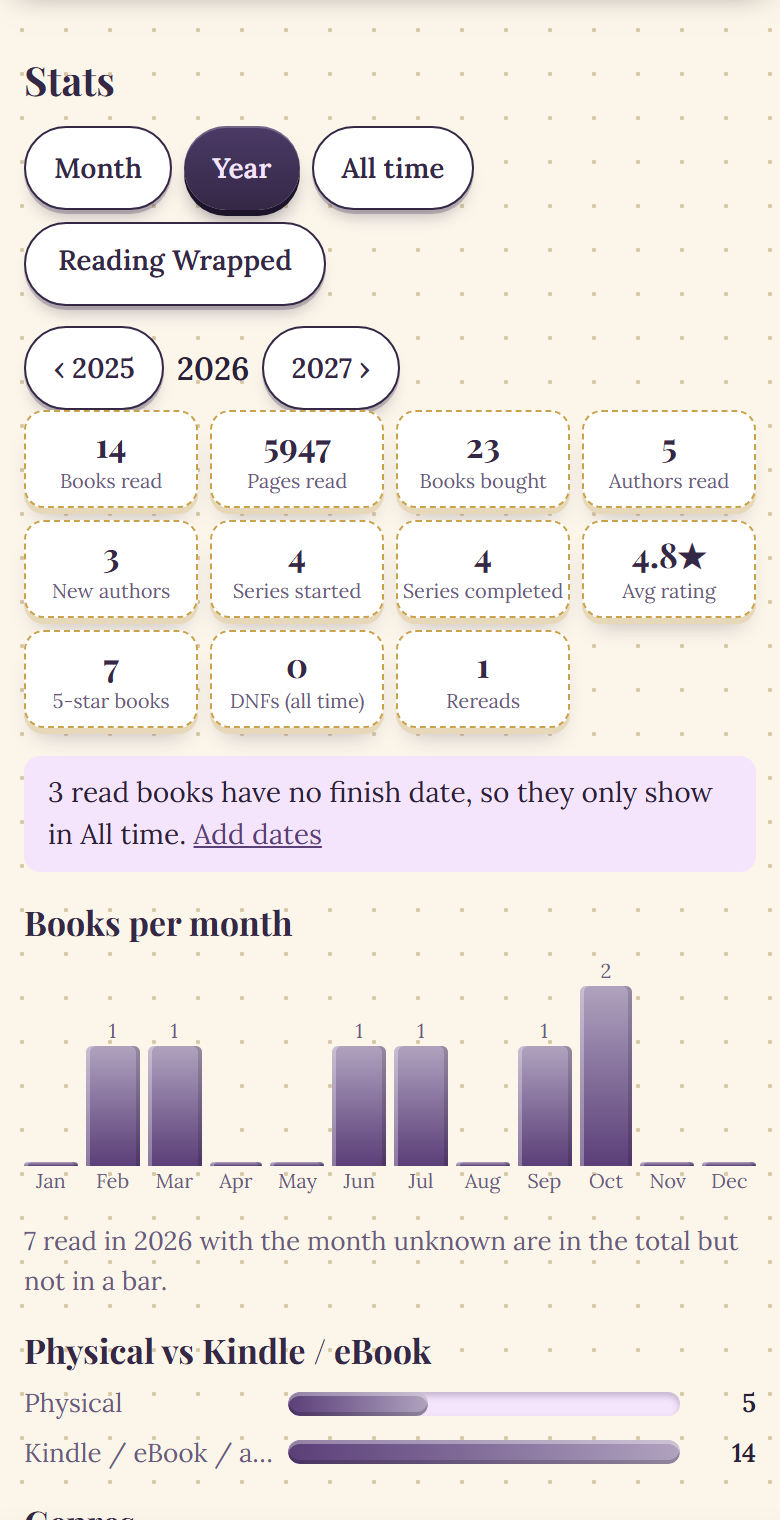
The Year tab on the Stats page, with the books per month chart, in a sample library.
Check the chart at your quarter checkpoints, and if slow months match a busy season, plan for them next year. Everything is worked out live from your library, so there is nothing to tally. For a bigger picture of your year, see your year in books.
When Dog-Ear is not what you need
A paper tally, a spreadsheet or a sticky note on the fridge works well for a simple books goal, and it costs nothing. The books goal shows how many books are left but not an on pace figure, so the quarter checkpoints above are yours to do. It makes most sense if you want the count, the shelf and your stats to fill in from one library. On the free plan you can keep 50 books, wish list included, so a challenge of 50 or more may need the full version. Here is what the free plan includes, and how the journal pages work.
Set a goal you will reach
Set your number, finish books, and watch the shelf fill in. $29, one time, no subscription.
Get Dog-Ear for $29Questions
How many books should I set as a reading goal?
Start from what you actually finished last year. A common rule of thumb is to add a small amount, such as 20 to 30 percent or a few books. If you have no record yet, track this year and pick next year's number from real data.
Is a books goal or a pages goal better?
Neither is better for everyone. A books goal is simple and satisfying to see. A pages goal is fairer if your books vary a lot in length, because a long book then counts for more. Dog-Ear lets you keep both.
What should I do if I fall behind on my reading challenge?
Check the number against your real pace, then change what needs changing: lower the goal, switch to a pages goal, count formats you left out, or add a few short books. Adjusting a goal is not cheating if the original number no longer fits your life.
Do audiobooks, rereads and DNFs count toward a reading challenge?
That is your rule to make, and the key is deciding before you start. In Dog-Ear, any book you finish counts whatever the format, a reread adds to the books goal, and a book marked DNF does not count.
Related: A free book tracker for your first 50 books, A digital reading journal with stickers, What is a TBR and how to get through it, Reading slump causes and fixes.