How do you track books you did not finish, and is it worth it?
The short answer: Give your did not finish (DNF) books their own list instead of leaving them on your to be read pile or deleting them. Write down the page you stopped at and one reason, and mark whether you might try again. In Dog-Ear, the Didn't finish button sends a book to a page called the DNF Graveyard, where you can add those three things.
DNF means "did not finish." Almost every reader has a book they stopped at page 80 and never touched again. Where does it go? If it stays on your shelf marked "reading," it quietly bothers you. If you delete it, you lose the record that you tried it, and in six months you may pick it up again and forget why you stopped. A small, honest DNF list fixes both.
Why keep a record of books you stopped?
- It stops the book from haunting you. A book left as "currently reading" for a year is clutter. Moving it to a DNF list is a decision, and decisions feel lighter than guilt.
- It keeps your reading numbers honest. A book you stopped is not a book you finished, and a list that says so is easier to trust.
- It shows patterns. Readers who track this sometimes find things like "I quit a lot of very long books" or "the third book in a series is where I stop." Those are examples of what you might see, not a promise. Only your own list can tell you.
- It saves you a repeat. If you wrote "too slow in the middle," you will not pick the same book up again by accident.
Is it okay to quit a book?
Yes. Putting a book down is allowed. Readers give many reasons: the library loan ran out, they picked it up out of duty, the writing did not work for them, or the subject was not for them. None of those mean you read wrong. A shorter pile of books you want to read is better than a long one you dread. If you are not reading at all, and not just quitting one book, the guide to reading slump causes and fixes is the better place to start.
Some readers use a trial rule, such as giving a book about fifty pages before deciding. That is one person's rule, not a law. Pick a number that suits you, or decide by feel.
What should you write down when you DNF a book?
Keep it to three small things, so you will actually do it:
- Where you stopped. A page number or a rough spot ("page 120," "after the wedding").
- Why you quit. One short reason ("too slow," "not in the mood," "did not like the narrator").
- Will you try again? Yes, maybe someday, or never.
The "maybe someday" answer matters most. Many books are not bad, they just arrived at the wrong time. A note that says "try again in summer" is worth more than a vague memory.
How does Dog-Ear handle DNFs?
Dog-Ear has a DNF Graveyard page in the journal. Here is how a book gets there.
- From a book you are reading. Open the book and tap Didn't finish. The book goes to your DNF Graveyard right away. After that, Dog-Ear asks if you want to say why, and that part is optional. You can save a short note or skip it.
- From a book you stopped a while ago. Open the Journal, go to the DNF Graveyard page (the tab on the side says DNF), choose the book from Send a book to the graveyard, and tap Bury it.
- On the page itself. Each book gets a small tombstone with its cover, title and author, and three boxes: Where I stopped, Why I quit and Try again? with the choices Yes, I will try again, Maybe someday and No, never.
If you change your mind, open the book and change its status. The book is not stuck in the graveyard. To see where else it fits, our post on what a TBR is and how to get through it covers how to keep the pile you own separate from the pile you only want.
Your count of DNF books also shows up in your year recap. The reading recap page lists how many books you did not finish, all time. If you want to know what else goes into it, see your year in books. To pick something better to read after a DNF, try how to choose what to read next.
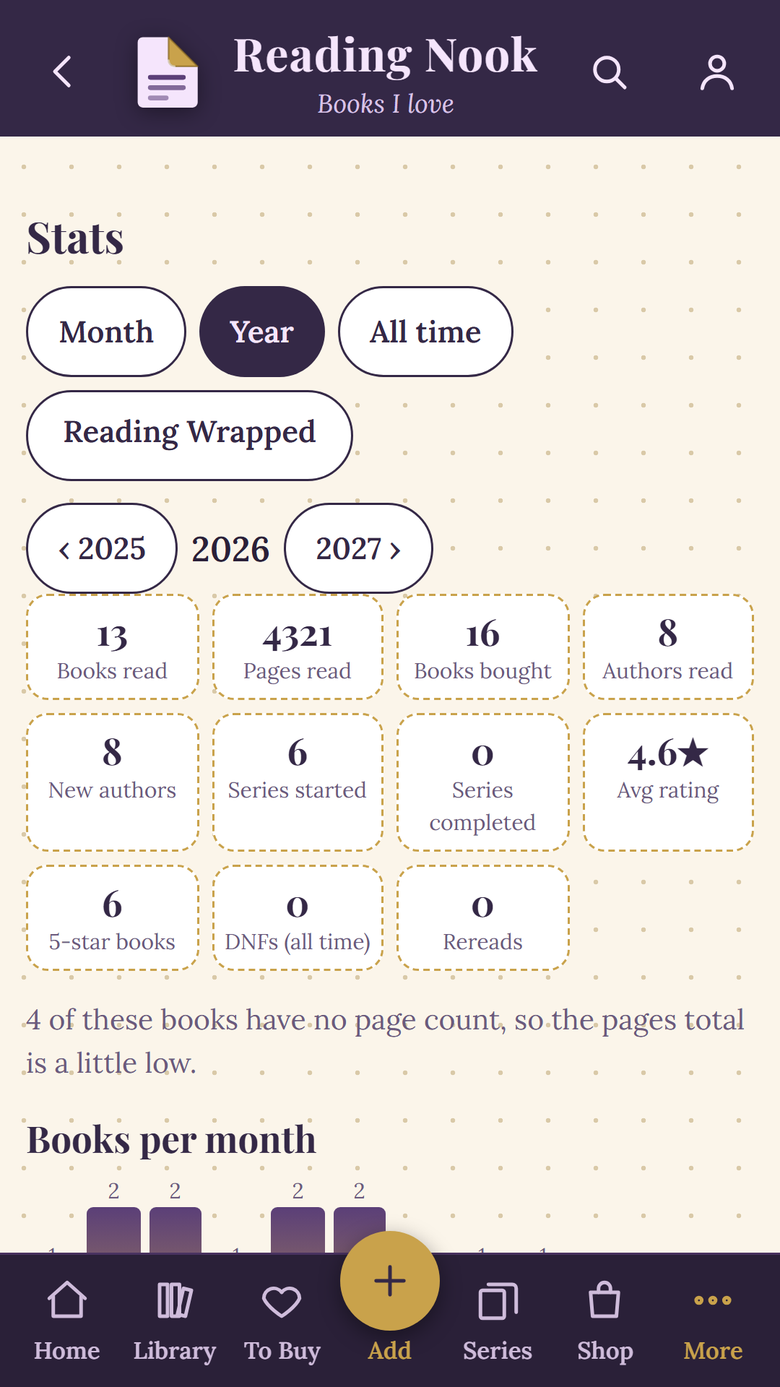
The Stats page, which has a DNFs tile, in a sample library.
Do you need an app to track DNFs?
No. A notebook page titled "DNF" works. So does a spreadsheet with three columns: title, page, reason. The one thing that matters is that the list exists and that you write the reason while you still remember it. An app only helps if you will remember to open it.
When is this not for you?
If you never quit books, or you are happy to forget them, skip this. A tracker should help you read, not give you another chore. Also, if the idea of a graveyard feels grim, rename it in your own head. It is only a list of books that taught you what you do not like.
Give the half read books somewhere to rest
If you are curious, Dog-Ear is at dogearreads.com. A notebook page works just as well if you prefer paper.
Start freeQuestions
What does DNF mean?
DNF stands for "did not finish." Readers use it for a book they stopped reading before the end.
Does a DNF book count as a book I read?
That depends on your own rules. Some readers count a book if they got past a certain point and some never do. Whatever you pick, keep the same rule all year so your numbers stay comparable.
Where do I put DNF books in Dog-Ear?
Tap Didn't finish on the book, or open the journal's DNF Graveyard page and use Bury it. Both put the book in the graveyard, and you can add where you stopped, why, and whether you will try again.
Can I take a book out of the DNF list?
Yes. Open the book and change its status. Nothing is deleted when a book goes to the graveyard.
Should I finish every book I start?
No. Plenty of readers set a book aside and are happier for it. A tracker can make that decision calmer, because the book has a place to go.
Related: Reading slump causes and fixes, What is a TBR pile, and how do you get through it?, How to get a reading wrapped worth reading.