How many pages a day do you need to read to hit a yearly goal?
The short answer: Divide your yearly pages goal by 365. A goal of 10,000 pages comes to about 27 pages a day, or about 192 pages a week. In Dog-Ear, the Pages Read page does this for you: it shows your total, about how many pages a day you are averaging, and what you are on pace for this year.
A goal in pages can feel more honest than a goal in books, because one reader's 200 page novel is another reader's 900 page epic. Pages treat both fairly. But a number like 10,000 pages means little until you turn it into something you can do on a Tuesday night. That is all this post does.
How many pages a day does each yearly goal need?
Here are some round goals. The math is plain: pages per year divided by 365 for the daily figure, and the daily figure times 7 for the week. Both are rounded.
| Yearly pages goal | Pages a day | Pages a week |
|---|---|---|
| 5,000 | about 14 | about 96 |
| 7,500 | about 21 | about 144 |
| 10,000 | about 27 | about 192 |
| 12,500 | about 34 | about 240 |
| 15,000 | about 41 | about 288 |
| 20,000 | about 55 | about 384 |
If you want a different number, take your goal, divide by 365, and round up. If your goal is for part of a year, divide by the number of days you have left instead.
How long does that take?
That depends entirely on you. Reading speed varies a lot between people and between books, and a dense nonfiction book is slower than a fast thriller. So do not borrow a number from anyone else. Time yourself:
- Set a timer for ten minutes.
- Read at your normal pace, with no phone in sight.
- Count the pages you got through. Multiply by six for an hour.
Now you can see how much of your day a goal asks for. Many readers find a modest goal is already a lot, and a big goal asks for audiobooks, commutes or a lunch hour. Our guide to setting a reading challenge you will finish talks about choosing a goal from what you really read, and about leaving a buffer. If counting pages does not suit you, an A to Z reading challenge is a gentler way to play.
How do you know if you are on pace?
Check once a month with two numbers:
- Pages read so far.
- Days gone so far this year.
Divide the first by the second. That is your average pages a day. Multiply it by 365 and you have the total you are on pace for. If that is below your goal, you do not need a miracle, just a bit more each day. If it is above, you can relax or raise the goal.
One small trap: a pages goal is lumpy. A long book that you finish in one month makes that month look huge, and a stretch of slow reading makes the next look flat. Look at the whole year, not one month.
How does the Pages Read page in Dog-Ear work?
Dog-Ear has a journal page called Pages Read Tracker. The tab on the side says Pages.
- A goal you can change. The page starts with a goal of 10,000 pages for the year. You can type a new number and tap Change goal.
- Your total. It shows the pages you have read toward the goal, with a bar and 20 small boxes. Each box is one twentieth of your goal, so for a 10,000 page goal each box is 500 pages.
- Pages per month. A little bar chart shows how many pages you finished in each month.
- The pace lines. It says "About X pages a day," and, for the current year, "On pace for Y pages this year." If you beat the goal, it tells you by how many pages.
Two honest details about how it counts. First, pages are counted when you finish a book, using the finish date. A book you are halfway through does not add its pages yet. Second, a book with no page count adds nothing, and Dog-Ear tells you how many finished books are missing a count so you know your total is a little low. Our post on fixing a book's page count shows how to add them.
Books you finished without a month are also left out of the bars, and the page says how many. If you want to see your whole year at once, your year in books describes the recap.
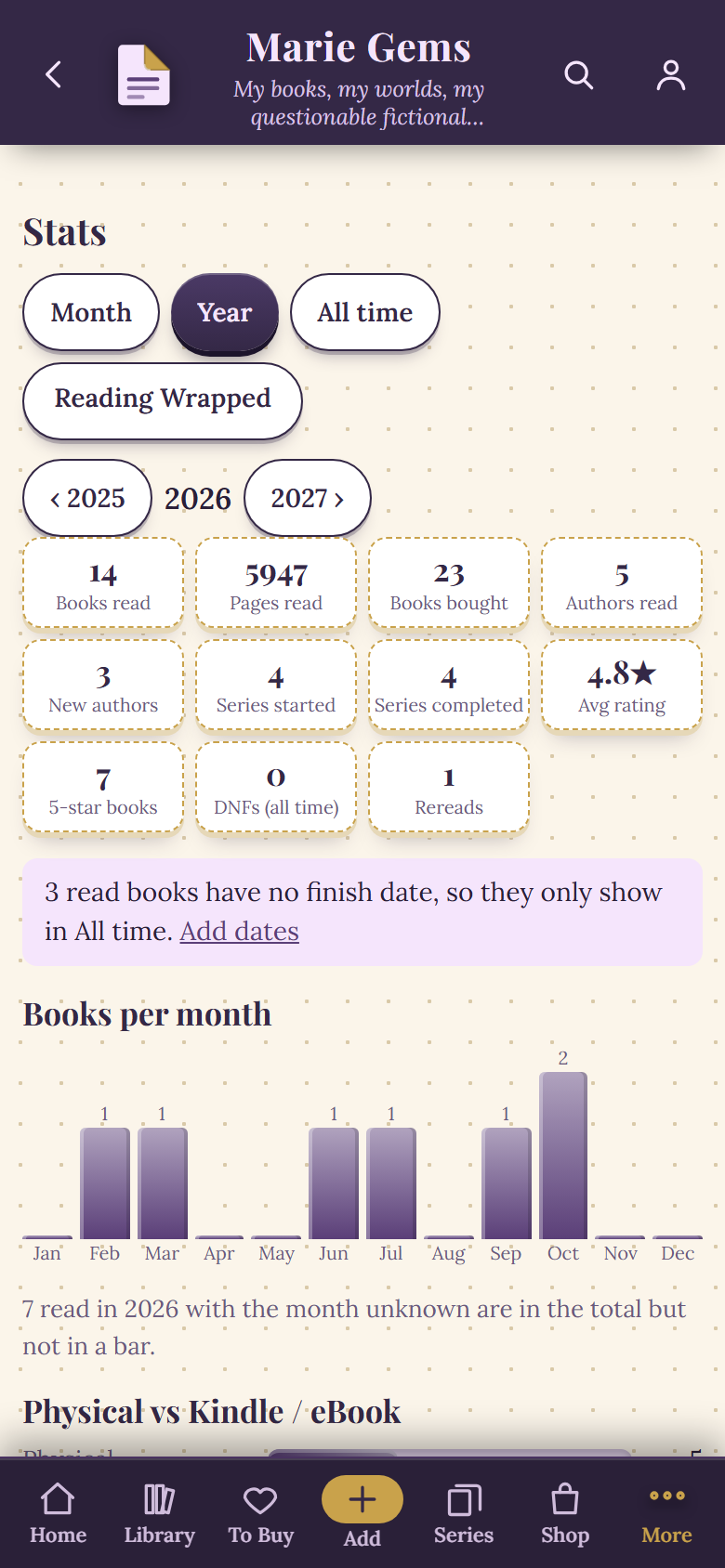
The Stats page with a Pages read tile, in a sample library.
What if you fall behind?
Do not try to catch up all at once. If you are behind, spread the missing pages over the days left. A gap of 300 pages over 60 days is five extra pages a day. Or lower the goal. A goal is there to help you read, and changing it is allowed.
When is this not for you?
If you read for pleasure and do not care about numbers, a pages goal is only another thing to feel behind on. Skip it. A pages goal also fits badly if you mostly listen to audiobooks or read books with unusual page counts, such as graphic novels, since pages may not match the time you spend.
See your pace without the math
If you are curious, Dog-Ear is at dogearreads.com. A notebook, a calculator and a monthly check will do the same job.
Start freeQuestions
How many pages a day is a good amount to read?
There is no right number. Pick a goal, divide it by 365, and see if the daily figure fits your life. About 27 pages a day adds up to roughly 10,000 pages in a year.
How do I turn a yearly pages goal into pages a day?
Divide the goal by 365. For part of a year, divide by the days left.
Does Dog-Ear count pages while I am still reading a book?
No. It counts a book's pages when you finish it, using the finish date.
What is the default pages goal in Dog-Ear?
10,000 pages for the year, which you can change on the Pages Read page.
Why is my total lower than I expected?
Some finished books may have no page count, so they add nothing. Dog-Ear shows how many, and you can add the counts.
Related: How to set a reading challenge you will finish, How to fix a book's page count in Dog-Ear, How to get a reading wrapped worth reading.